

Conflict-of-Interest Disclosure in Hong Kong’s ‘Patriots-Only’ Legislative Council
Introduction
In December 2025, the Hong Kong Legislative Council (LegCo) held elections for its Eighth Term, and the Members began serving in January 2026. This is the second LegCo Term following the 2021 electoral reforms, which mandated that candidates be vetted and swear oaths, ensuring a “patriots-only” LegCo.
This research follows from the China Strategic Risks Institute’s 2025 publication ‘The Declining Accountability and Transparency of Hong Kong’s Legislative Council: how the ‘Heart of Democracy’ impacts the Business Environment.’ It detailed how LegCo has failed to effectively exercise accountability and uphold transparency in a time of dramatic change in Hong Kong’s politics.
To complement the previous findings, this paper examines and compares the asset declarations of the Seventh and Eighth Term LegCo Membership and analyses whether they align with the Members’ patriotic positions, and whether this shows LegCo’s increasing political isolation.
Methodology
With the support of the Center for Advanced Defense Studies (C4ADS), which saved and organised data from the LegCo’s Seventh Term and Eighth Term Register of Members' Interests, the researcher coded and analysed the properties declared by each Member.
The research includes declared properties for self-use and rental, commercial and residential spaces, as well as carpark spaces. It also includes properties that are co-owned (with a spouse and/or family members) and owned through a company. Each of these is marked as 1 property.
In some cases, there is an unclear number of properties, so an estimate was made. If ‘property’ was declared, it was marked as 1 unit, and if ‘properties’ were declared, they were marked as 2 units. In cases where a Member’s property ownership changed, the peak amount during their term was recorded. Properties in Macau were recorded under “Mainland China”.
Overall Trends
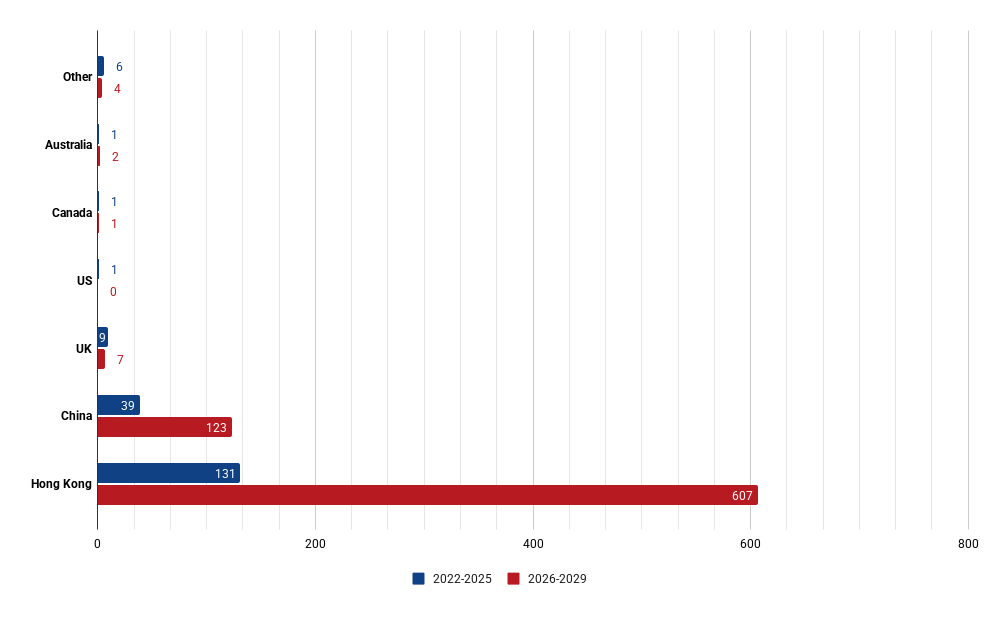
Figure: Locations of LegCo Members’ Properties
Source: Authors’ own analysis based on Official LegCo records.
Overall, the number of properties owned by LegCo Members has increased from the Seventh to the Eighth term.
The Eighth term Members have 3.15 times as many properties in Mainland China (including Macau), at 123 properties compared to 39. While Members’ patriotism is hard to measure and LegCo has introduced many tests, these Members’ personal financial investments in Mainland China are a way of signalling their patriotism, “putting their money where their mouth is” in the eyes of both the public and Beijing.
Most LegCo Members have at least one property in Hong Kong, and in most cases, it is a residential property for personal use. This is logical and aligns with their political positions.
Nevertheless, there are also more properties in Hong Kong, although the change is harder to measure. In the Seventh Term, Kenneth Ip-keung LAU declared that he had “lands and properties in New Territories [and] land at Huizhou and Wuhan in China” whereas in the Eighth Term, he declared that he had 458 properties in Hong Kong and 2 properties in Mainland China. He is by far the Member with the most properties, but it is not clear what the increase is between the two terms, and this huge jump makes the discrepancy difficult to analyse.
Properties Elsewhere
There is also a trend that Members own fewer properties outside of Hong Kong and Mainland China, choosing to keep their assets closer to home rather than abroad. This may reflect their increasing pro-China and anti-Western stance, which is reflected in their political decisions as Members of the “patriot-only” LegCo, and perhaps it reflects their personal financial choices too. In the Seventh Term, Members had a total of 18 properties outside of Hong Kong and Mainland China, and the number dropped to 14 in the Eighth Term.
This reduction may also be related to LegCo Members’ perceived risk of being sanctioned by Western countries. Hong Kong’s Chief Executive Carrie Lam and several Executive Council Members have been subjected to US sanctions, which have excluded them from international banks and the financial system more broadly. Lam famously complained that she had to make all her payments in cash as a result. If Members are worried about Western sanctions, Western assets will be a liability whereas assets in Hong Kong and Mainland China will not.
Notable Individuals
In the Eighth Term, Kenneth Ip-keung LAU has by far the most properties, with a total of 460 assets in Hong Kong and Mainland China. He is succeeded by Kai-kong Kenneth FOK who owns 44 properties in Hong Kong, Mainland China, France, and the UK, and Ka-keung LAU who owns “23 parking spaces and 23 commercial shops held for investment purposes in China”.
Ka-keung LAU is serving for the first time in 2026, whereas the other two are returning LegCo Members. All have positions in the National People’s Congress (NPC) and/or the National Committee of the Chinese People's Political Consultative Conference (CPPCC), among other affiliations related to the Chinese Communist Party (CCP) or organisations promoting friendship between Hong Kong and Mainland China.
Not all LegCo Members have such senior positions at CCP institutions, nor are all Members as enthusiastic about cooperation between Hong Kong and Mainland China. These Members’ overt patriotic actions and their personal assets align with their pro-Beijing stance, and their investments may be a way of indicating their patriotism, or it may be a benefit of their engagement.
Directorships in Chinese Companies
The Members of the Eighth Term also have more directorships (including paid roles) at significant Chinese Companies, many of which are state-supported and financially dependent on Beijing’s policies, showing that these Members are more closely linked with Beijing’s political and economic decision-making circles. This reflects that their interests are increasingly aligned with Beijing’s and may lead LegCo to make increasingly pro-Beijing decisions as Members have a personal financial stake.
In the Seventh Term, Gary ZHANG was a strategy advisor at the Industrial and Commercial Bank of China. Hak-kan CHAN was a Deputy Director in the New Energy Strategic Development Committee and then the ESG Committee of Sinopec (Hong Kong) in the Seventh and Eighth Terms.
In the Eighth Term, Nick Hiu-fung CHAN is an Independent Non- executive Director at Ping An Insurance (Group) Company of China, Ltd.
Sensitive Chinese Companies
On top of this, in the Eighth Term, a much higher number of LegCo Members have remunerated and non-remunerated roles at Entities that are Identified as Chinese Military Companies according to the US Department of War.
In comparison to the above list, these indicate the Members’ stronger support for Beijing’s policies and that they are less afraid of being restricted from Western countries or institutions, as their affiliations with these companies are public and the companies are listed by the US. Being affiliated with these sensitive Chinese Companies is also a way for these Members to express their patriotism and loyalty towards Beijing, as they are involved in more strategic industries and are willing to expose themselves to the risk of Western sanctions against these companies.
In the Seventh Term:
Elizabeth QUAT, Hailong SHANG, and Duncan CHIU were consultants at China Mobile Hong Kong Company Limited;
Hailong SHANG was a Strategic Consultant on Artificial Intelligence at SenseTime Group Limited;
Johnny Kit-chong NG was an independent director at China United Network Communications Limited.
Also, in the Seventh Term, Chung-hung LUK and Ka-piu TANG took a trip to Shanghai, Nanjing, and Wuhu in China, sponsored by CRRC Group, “To conduct a site visit for taking forward the construction of the 'crossing-the-hill line' of the East Kowloon Line.”
In the Eighth Term:
Han-pan CHAN is a vice-president at China State Construction International Holdings Limited;
Duncan CHIU is an Independent Non- executive Director at SenseTime Group Inc;
Andrew Cho-fai YAO has a directorship at China COSCO Shipping Corporation Limited;
Han-pan CHAN is a Vice President at China State Construction International Holdings Limited, the largest construction contractor in Hong Kong, but also a subsidiary of China State Construction Engineering Corporation Limited (CSCEC) which is on the list;
Andrew Chun-wah FAN is an independent Non- Executive Director China Unicom (Hong Kong) Limited and has a directorship at China Unicom (BVI) Limited;
Pui-kong CHEUNG is Director of Public Relations at China State Construction Engineering (Hong Kong) Limited;
Johnny Kit-chong NG is an independent director at China United Network Communications Limited;
Michael Ming-tak NGAI is an External Director at CRRC Corporation Limited.
Education
Finally, Eighth Term Members also have more links to Mainland Chinese institutions than their predecessors. The Asset Declarations include a range of affiliations ranging from membership in an alumni association to the position of dean at university departments. To make a more objective comparison, this research focuses on the professorships only (including honorary professorships).
In the Seventh Term, Dennis Shun-chiu LAM, Wendy Wen HONG, Chi-pang LAU, and Priscilla Mei-fun LEUNG had professorships at institutions located in Mainland China. Kenneth Kai-kong FOK, Nelson Chi-yuen LAM, Starry Wai-king LEE, Priscilla Mei-fun LEUNG, Man-yu NGAN, Dong SUN, Chi-yuen TIK, William Kam-fai WONG, and Yuen-shan WONG had professorships at institutions located in Hong Kong. No Members had professorships located at institutions abroad.
In the Eighth Term, the number of professorships overall and professorships in Mainland China have increased. Pok-chi CHAN, Wing-kwong CHAN, Chi-pang LAU, Priscilla Mei-fun LEUNG, and William Kam-fai WONG have professorships at institutions located in Mainland China. Additionally, Hoey Simon LEE is a director (non-remunerated) at the Tsinghua Law Association (Hong Kong) and a Researcher at the Renmin University of China. Aaron Kwok-ming BOK, Wing-kwong CHAN, Vincent Wing-shun CHENG, Alex Hoi-kit FAN, Kenneth Kai-kong FOK, Chi-pang LAU, Starry Wai-king LEE, William Kam-fai WONG, Thomas Shiu-tsung SO, and Peter Douglas Ho-ming KOON have professorships at institutions located in Hong Kong. Michael Ming-tak NGAI is an honorary professor at Satbayev University in Kazakhstan.
These numbers show that LegCo Members are more closely aligned with Beijing’s leadership because of their affiliations with Mainland Chinese academic institutions, which are all vetted and funded by the CCP. In these roles, they engage with and network with Chinese academics, bringing these ideas and opportunities back to Hong Kong, where they exert influence in LegCo or in Hong Kong institutions where they also have professorships. This trend shows the increasing closeness between Hong Kong and Mainland Chinese research and policy, and that Hong Kong is shifting further away from Western institutions and norms.
Analysis
Comparing the data from the last two terms’ Register of Members' Interestsreflects the increasing political decoupling of Hong Kong from the rest of the world, whether it is in individual assets, business links, or academia.
The Eighth Term Members have 3.15 more properties in Mainland China than their predecessors, they have more links to state-linked Chinese companies including ones that are linked to the military, and they also have more affiliations with Mainland Chinese institutions. At the same time, they have properties and other links abroad.
This shows that Members are using diverse means to express their patriotism towards Beijing, but also that they are aligning themselves closer to Beijing and isolating themselves from the West. They are closer to Beijing in terms of assets, political agenda, and policy. They are now more willing to affiliate with US-sanctioned Chinese companies and have fewer assets abroad that could be confiscated.